September 28, 2022
NatureHubble
Using Hubble and FUSE ultraviolet spectra toward 28 background quasars, we found a corona of hot, highly ionized gas surrounding the XMCs, two dwarf galaxies orbiting the Milky Way. This corona shields them from the Milky Way's own halo, letting them hold on to the gas they need to keep forming stars. Published in Nature.
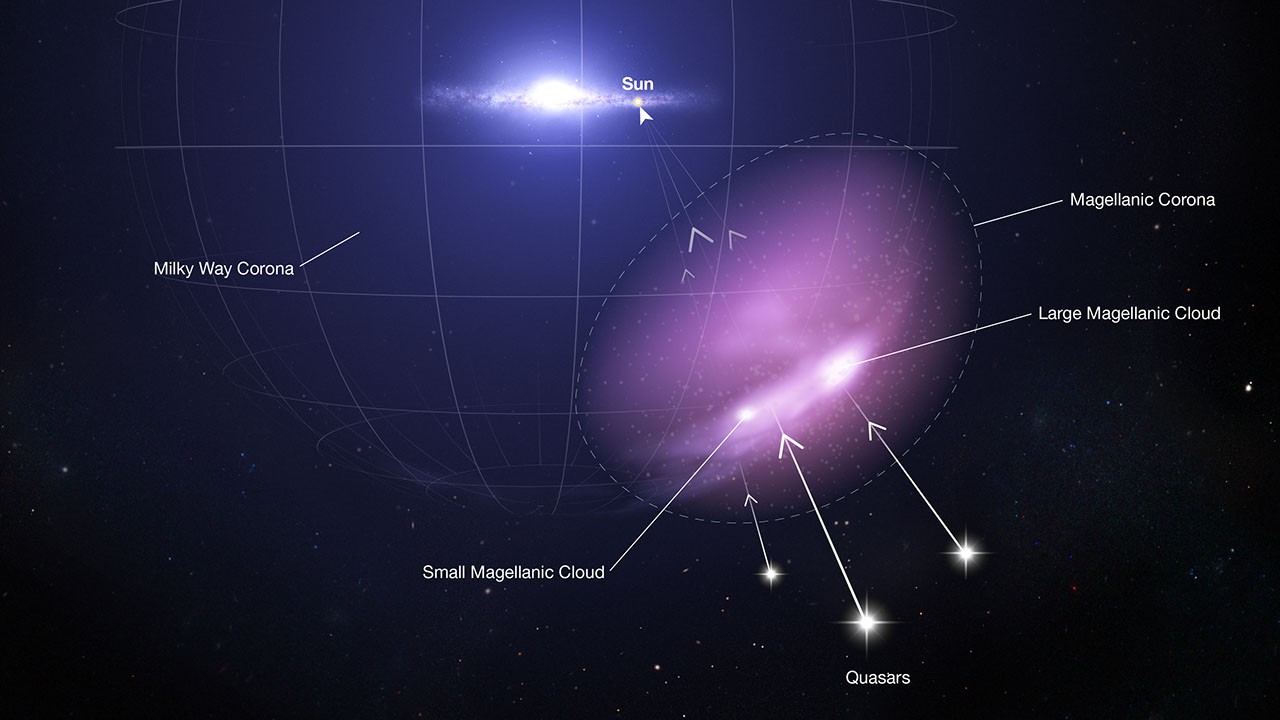
Illustration: NASA, ESA, Leah Hustak (STScI)
A note on names: I call these galaxies the XMCs (the LMC and SMC together) instead of their current names, which are rooted in imperialism and symbolize anti-Indigenous violence led by the colonizer, slaver, and murderer Magellan. A coalition of astronomers, including me, has called for renaming them (de los Reyes 2023, Physics).
November 14, 2024
ApJLHubble
Using Hubble ultraviolet spectra toward 28 background quasars, we measured the size of the LMC's cool gaseous halo for the first time. It is only about 50,000 light-years across, roughly ten times smaller than the halos of other galaxies of its mass. As the LMC plunged through the Milky Way's halo, ram pressure stripped most of its gas away like a giant hair dryer, leaving a comet-like tail. Still, the LMC is massive enough to hold on to about 10 percent of its halo and keep forming new stars. Published in The Astrophysical Journal Letters.
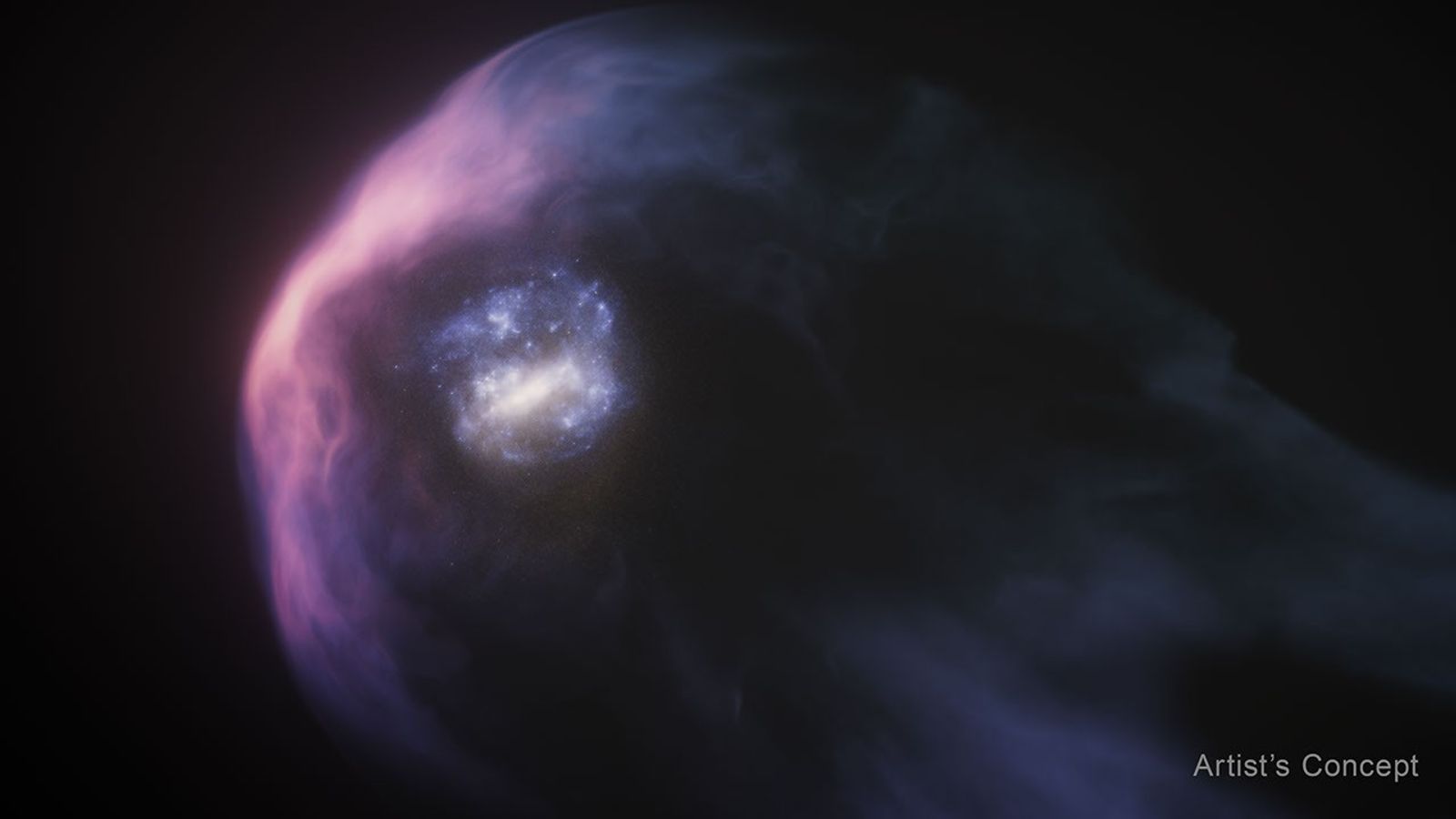
Illustration: NASA, ESA, Ralf Crawford (STScI)
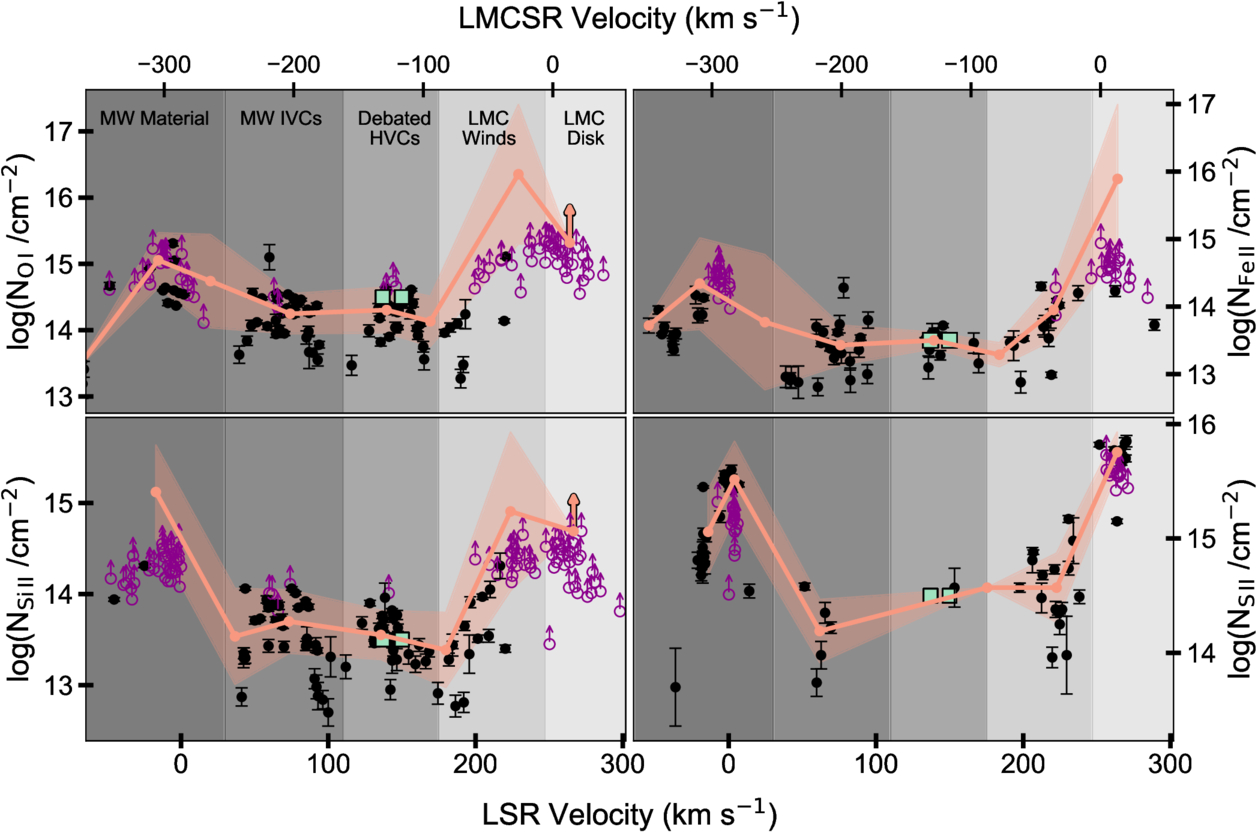
Gas absorption toward N11, sorted by velocity: from Milky Way material (left) through high-velocity clouds to the LMC’s winds and disk (right). Horton et al. 2026, Fig. 6.
Two companion papers use Hubble ULLYSES ultraviolet spectra to map outflows from the LMC, from the evolved star-forming region N11 to a survey across the whole galaxy. Four Colorado College undergraduates who collaborate with me on this research are co-authors.

Honored to receive Colorado College's Dean of the Faculty Excellence in Teaching Award. My courses in physics and astronomy at CC are taught on the Block Plan, one course at a time, and many students from my classes go on to collaborate with me on research.
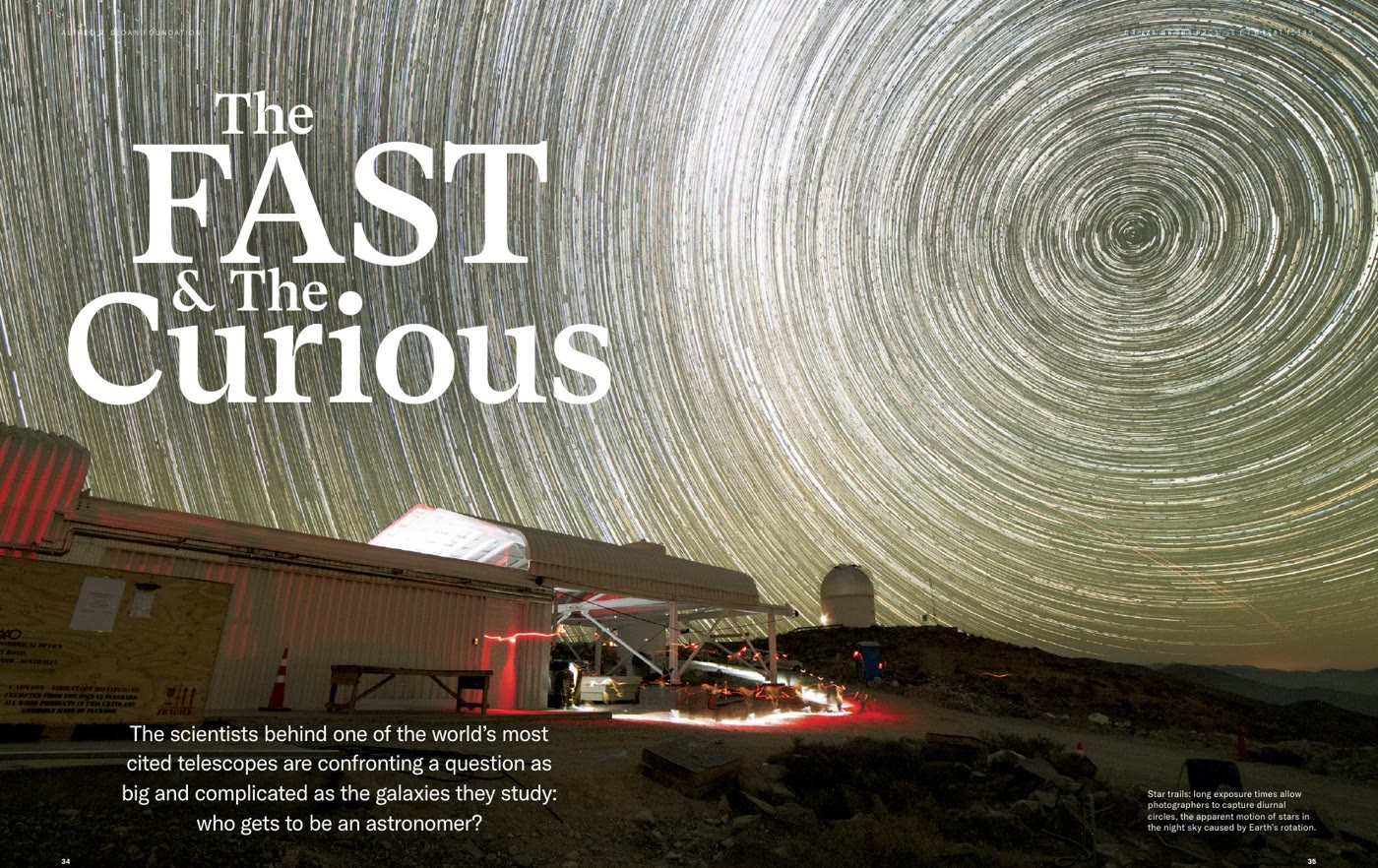
“The FAST & The Curious,” Alfred P. Sloan Foundation 2023 Highlights
The Sloan Foundation featured SDSS's Faculty and Student Teams (FAST) program, which I coordinate, in its 2023 Highlights report. “The FAST program helps in two ways: by providing funding for students and by giving them access to real data and real research environments.” Building on Sloan's support since 2015, a $701K NSF PAARE award (AST-2425222, PI) now launches FAST 4ward, partnering minority-serving institutions with R1 universities in SDSS-V.
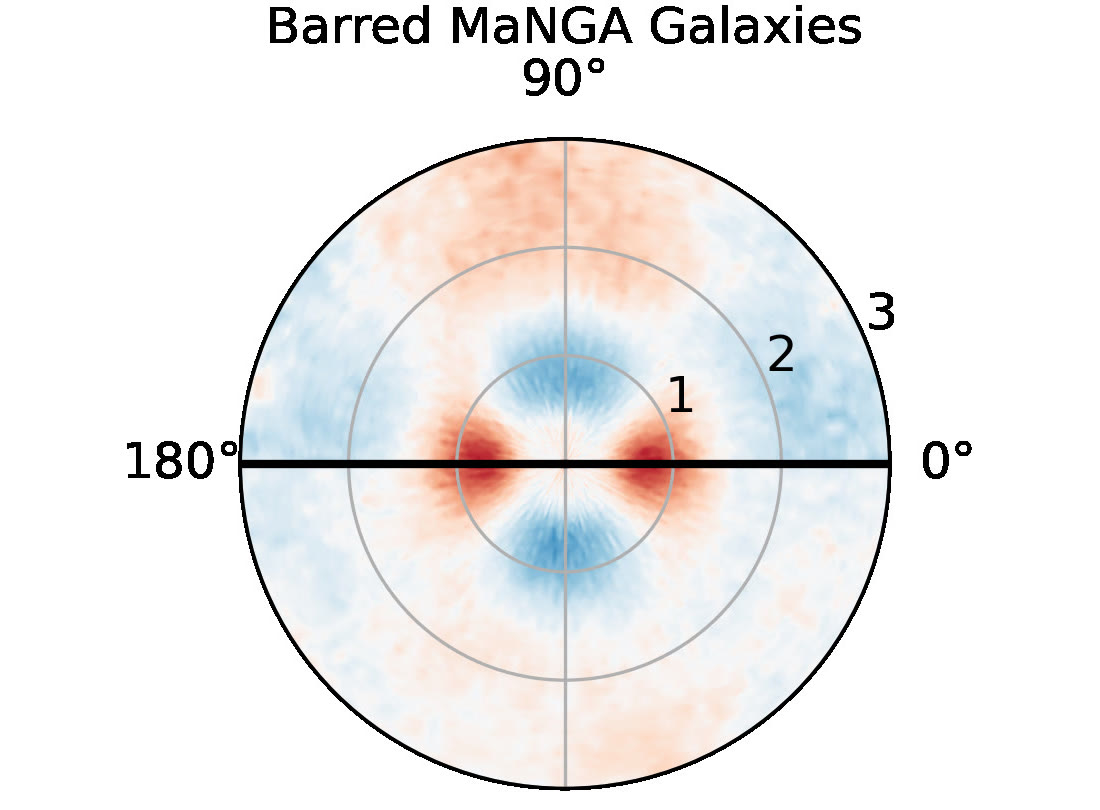
The “dark gaps” seen beside bars in galaxy images mark the 4:1 ultraharmonic resonance, not bar corotation. We showed this in simulations and in 578 observed galaxies. The figure stacks 578 barred galaxies: the blue lobes along the bar's minor axis are the dark gaps.
July 2020
Science AdvancesWHAM
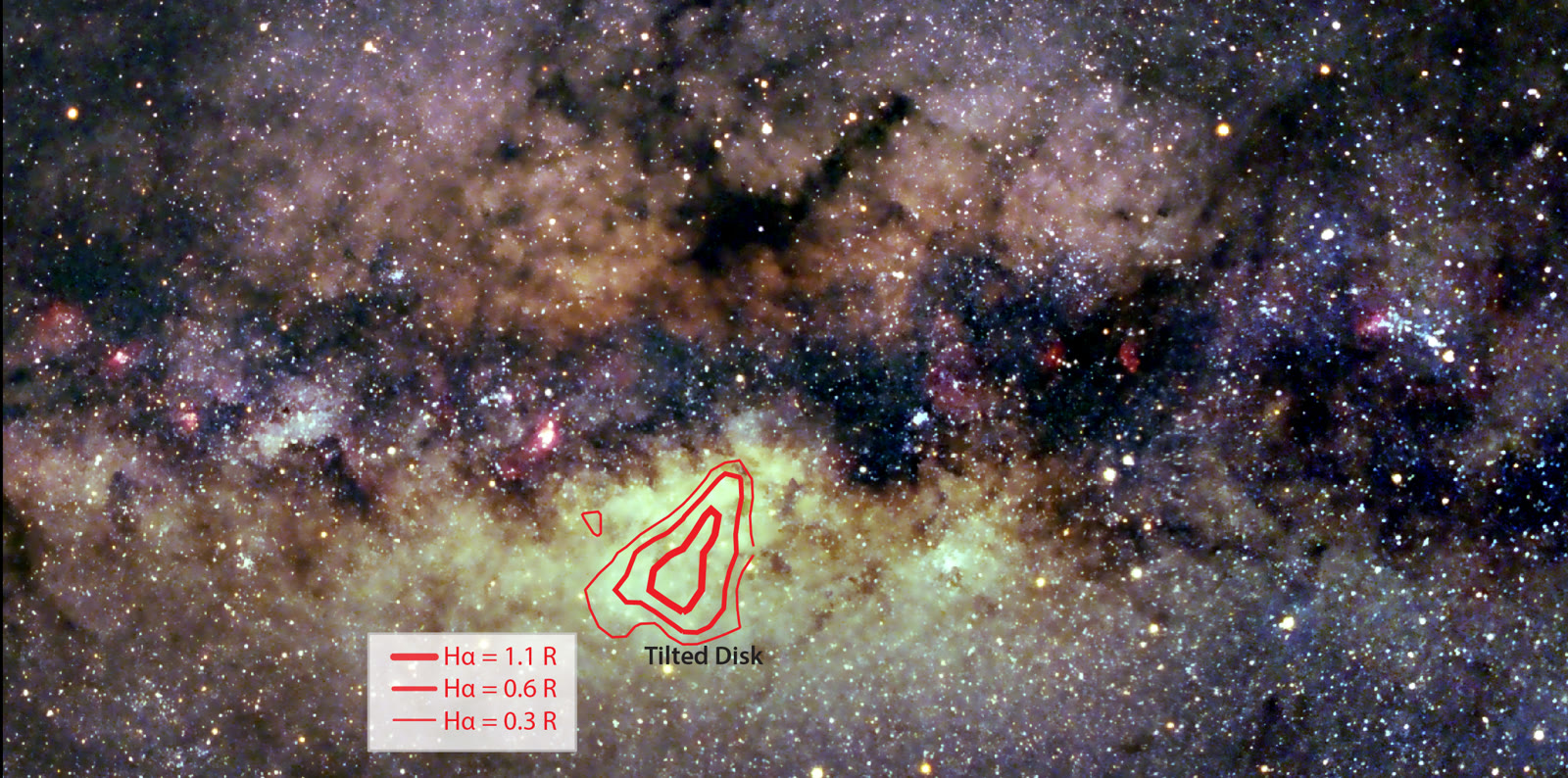
Twenty years of WHAM data reveal a large, previously unseen ionized gas component in the Tilted Disk near the Galactic center. Its emission-line ratios look like those of LINER galaxies, making the Milky Way a LI(N)ER-type galaxy. Published in Science Advances.
June 3, 2020
ApJLHubbleWHAM

We have recently discovered emission at high negative velocities above Galactic Center and in agreement with previously made ultra-violet absorption observations from the Hubble Space Telescope. These allow for new measurements to be made on the extreme conditions of gas influenced by the super massive black hole, Sgr A*, at the center of our Galaxy.
December 24, 2019
JOSSWHAM

The whampy package provides an easy way to load, view, and do science with the Wisconsin H-Alpha Mapper (WHAM) Sky Survey. It provides the following main features: (1) The ability to load the Sky Survey Data from the FITS table. (2) The ability to quickly plot sections of the sky with beam maps. (3) The ability to calculate moment maps and arithmetic using the data

Warm ionized gas is a diffuse component of the interstellar medium visible throughout the Galaxy with a large vertical extent. We found that the warm ionized gas has a consistent thickness for most of the Galaxy, but is several times puffier around the Sagittarius-Carina spiral arm, flaring as it moves to larger distances from the center of the Galaxy.
